
'During times of adversity, a brick becomes better than a stone. That is how I look at the election season.'

Upset over the valuation, Sudhakar Darade returned home and threw 13 quintals of onion in his field.
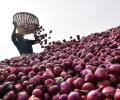
The model or average price for a kg of onion was Rs 6 on Monday -- the lowest in this late kharif and rabi harvesting season, so far. While poorer quality kharif onions traded at Rs 3 a kg, the price of export quality was Rs 9 a kg.

After government's measures like export ban and import from Pakistan, average wholesale prices of onion in Nashik district's various Agriculture Produce Market Committee (APMC) markets have come down by around 45 per cent to Rs 2,071 a quintal in the last three days.

A group of onion traders gathered at the Pimpalgaon Agricultural Produce Market Committee (APMC), near Nashik, to inspect one of the season's final harvests of red onions as they look to place their bids. They were surrounded by farmers, who brought their produce here from different parts of the district. Farmers have reasons to be optimistic.

The price per kilogram of onion came down to Rs 2 to Rs 4, which angered the growers, who had stopped the auction at the APMC last week for a day.

Maharashtra minister Dada Bhuse said the decision to impose export duty should have been taken with proper coordination.

Bhujbal stridently opposed Maratha quota activist Manoj Jarange's demand for Maratha quota from the Other Backward Classes (OBCs) share.

Barely days after imposing a 40 per cent export tax on onions to cool down soaring prices, which, in turn, triggered widespread protests across the main growing belts, the Centre on Tuesday sought to mitigate both political and economic tensions gripping parts of Maharashtra. It decided to procure an additional 200,000 tonnes of onions at Rs 2,410 per quintal for its buffer stock from farmers, a rate that is strikingly close to the price at which they were being exported before the 40 per cent duty was levied on August 19. The export price before the imposition of the duty stood at around $320 per tonne free on board (approximately Rs 2,650 per quintal).
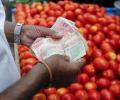
Trade sources believe that tomato supply from Maharashtra has slumped due to incessant rain in the state towards the fag end of the monsoon season, reports Dilip Kumar Jha.
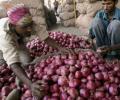
In the retail markets, fresh onion is sold between Rs 10 and Rs 12 a kg. Now, farmers have to sell onion at a loss of Rs 2-3 per kg if transport cost is included.

Devidas Parbhane said with onion prices touching new lows, farmers like me may be meeting the same fate as other farmers who committed suicide
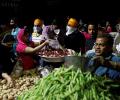
There have been several instances of traders dumping fruits and vegetables outside mandis. Or of farmers dumping produce outside their villages or feeding them to their animals.
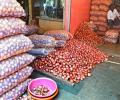
With auctions unable to proceed, the median onion price declined 17 per cent or Rs 6 a kg to trade at Rs 30 a kg on Monday, with arrivals of around 500 tonnes.
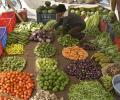
Onion supply in Nashik low but is expected to normalise in a couple of days
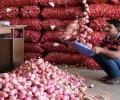
Despite onion prices hitting Rs 130 a kg in the wholesale market, farmers have not gained enough to make a profit this season. Farmers and other stakeholders in the value chain estimate that 30 per cent crop damage this kharif season would result in a decline of about 2 million tonnes in output from Lasalgaon district alone. Similar crop damage across the country could lead to an onion shortage of nearly 7 million tonnes this year.

Nilesh Veera, director of APMC said, complained that availability of workers is a big problem. They have asked the government to provide enough sanitizers, masks, etc, for worker safety, to call them back. There has been no reply.

The price of export quality lady's finger, for example, shot up 150 per cent in two weeks to close on Thursday at Rs 40 a kg against Rs 16 a kg on September 16 in the Agricultural Produce Marketing Committee, Vashi, near Mumbai.

Barring stray incidents of violence like stone pelting, the shutdown called by the MVA allies Shiv Sena, the Congress and the Nationalist Congress Party was largely peaceful.
Onion has become costlier by over 33 per cent in the last one week and over 70 per cent in September so far, reports Dilip Kumar Jha.

Normally, kharif sowing of vegetable seeds starts during the first week of May across the country. Farmers start preparing their fields to make them suitable for kharif sowing during the second fortnight of April. Now, however, faced with the lockdown, farmers are in a hurry to clear their fields of rabi crop and prepare for kharif planting. With a normal monsoon forecast this year, they are doing all they can to take advantage of pre-monsoon showers.
Onion is currently trading between Rs 70 and Rs 80 in retail markets across the country.
The crop is currently trading at Rs 22 a kg compared to Rs 12.50 one month ago.

Retail prices of tomato had touched almost Rs 80 per kg in major cities owing to short supply and transportation cost over the past few weeks following heavy downpour.
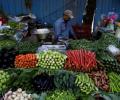
Vegetable arrivals at mandis, especially in Maharashtra, have declined by more than 50 per cent since the beginning of the month.

The concept of gold as an asset capable of getting anytime money is evaporating.

'Onion supply to mandis has declined due to its lower availability.'
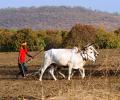
'We will be hoisting the tiranga, but this kind of celebration is uncalled for when the farmers in this country are dying by suicides, their families are ravaged by poverty and farmers are not enjoying any freedom.'

Prices start downward trend but rainfall, supply restrict climbdown.

A financial loss of Rs 8 to Rs 10 crore has been estimated due to the violence.
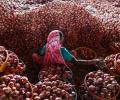
Traders say prices will remain elevated due to increased demand, lower availability
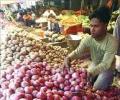
Sowing up 400%; prices may be low in 2014 as Maharashtra, MP and Bengal also likely to increase acreage 15-20%.
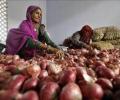
Prithviraj Chavan helping out Delhi's government tide over high onion prices has not gone down well in his home state of Maharashtra, says Neeta Kolhatkar.

'If the BJP thinks they can suppress the farmers' movement by opening fire, they are wrong.' 'It will create a boomerang effect which will be very difficult to manage.'
